Washing Machine Error Codes Guide
By the Appliance Repair Gastonia NC team • October 2026 • Gastonia, NC
Your washer stopped mid-cycle and is flashing a code — 4C, OE, UE, F21. This guide translates the codes for Samsung, LG, and Whirlpool machines, gives you the safe first step for each, and tells you when to call.
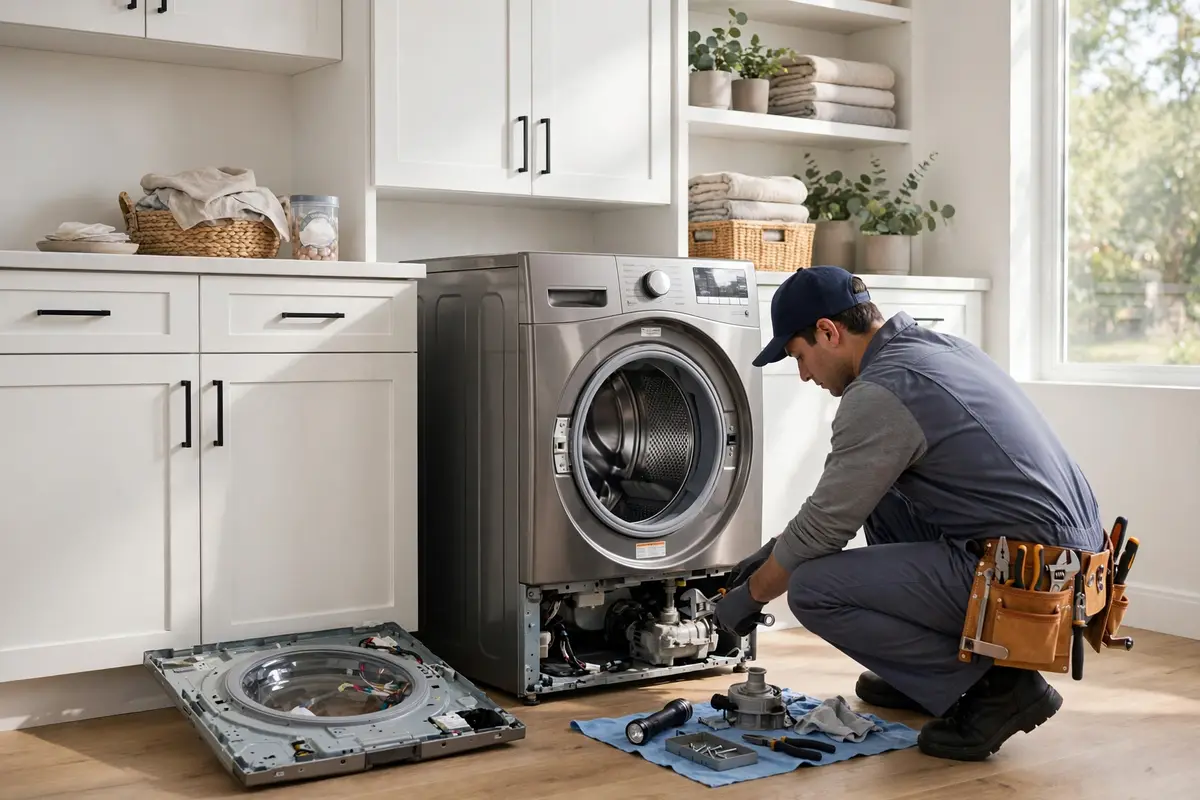
A washing machine error code always seems to arrive at the worst moment: the drum is full of wet laundry, the cycle timer is frozen, and the display is showing two characters that mean nothing to anyone who does not repair washers for a living. The code itself is actually useful information. Modern washers monitor water fill, drainage, door locking, motor performance, and load balance continuously, and when one of those systems falls outside its expected range, the machine stops to protect itself — and your laundry room floor — and reports which system complained.
The challenge is that Samsung, LG, and Whirlpool each use their own code language, and even within a brand the same letters can shift meaning between top-load and front-load models. This guide covers the codes Gastonia homeowners call us about most, organized by brand family, with the safe first step for each and an honest note on which codes clear with a simple fix and which ones mean a part has failed. Keep your model number handy — it is on a sticker inside the door or on the back panel — and if you decide you want help, our washer repair in Gastonia NC page covers same-day service across Gaston County.
Washing Machine Error Codes by Brand
| Code | Brand | Meaning | Safe First Step | When to Call |
|---|---|---|---|---|
| 4C / 4E | Samsung | Water supply problem — not filling properly | Check taps are fully open, hoses unkinked, inlet screens clean | If fill is still slow or code returns |
| 5C / 5E | Samsung | Drain problem — water not leaving the tub | Clean the pump filter (front-load), check drain hose for kinks | If pump hums but will not drain, or code returns |
| Ub / UE | Samsung | Unbalanced load — spin cannot proceed safely | Redistribute laundry, remove a bulky item, re-level the machine | If even small balanced loads trigger it — suspension or sensor wear |
| dC / dE | Samsung | Door not recognized as closed and locked | Firmly close the door, check for laundry trapped in the seal | If door clicks repeatedly or will not lock |
| OE | LG | Drain error — timed out draining | Clean the drain pump filter, straighten the drain hose | If filter is clean and draining is still slow |
| IE | LG | Inlet error — not filling within the time limit | Open supply taps, clean inlet filters, check house water pressure | If both taps run strong and code persists |
| UE / uE | LG | Unbalance error during spin | Rebalance the load, wash bulky items separately | If it happens on most loads — rods or bearings wearing |
| LE | LG | Motor lock error — drum cannot turn as commanded | Reduce an overloaded drum; reset power once | Immediately if drum will not turn by hand either |
| F21 | Whirlpool | Long drain — pump cannot empty the tub in time | Clean the pump trap, check the standpipe for blockage | If trap is clear and drain time is still long |
| F05 | Whirlpool | Water temperature sensor error | Reset power once and retry a cold cycle | If it returns — sensor or control testing needed |
| F06 / F07 | Whirlpool | Motor and speed feedback faults | Reduce load size and reset once | Yes — motor circuit diagnosis required |
| Sd / Sud | Whirlpool, Samsung | Excess suds detected | Run a rinse with no detergent; switch to correct HE dose | Rarely — only if it appears with no detergent at all |
Notice the pattern: fill codes, drain codes, balance codes, door codes, and motor codes cover almost everything. Once you know which family your code belongs to, you already understand the machine's complaint well enough to have a smart conversation with a technician — and to spot a dishonest quote that blames the control board for what is really a clogged pump filter.
Drain Codes: OE, 5C and F21 — the Most Common Call
Drain codes lead the league table in Gastonia laundry rooms, and happily, they are also the codes most often fixed without parts. Front-load washers have a pump filter — usually behind a small flap at the bottom front — designed to catch coins, buttons, hair ties, and the occasional sock before they reach the pump. When it clogs, draining slows, the machine times out, and OE, 5C, or F21 appears with a tub still holding water. Put towels down, have a shallow pan ready, open the filter slowly, and expect a surprising amount of water and an even more surprising collection of lost items. Our full walk-through of this family of failures lives in the companion guide, washer not draining, which covers pump testing and hose routing in detail.
When the filter is clean and the code persists, the fault moves downstream: a drain hose pushed too far into the standpipe and siphoning, a house drain that backs up under washer volume, or a pump whose impeller has worn or jammed on debris that got past the filter. A pump that hums loudly, grinds, or runs silently while water sits still has told you its story. Pump replacement is a mid-range repair within the typical $110–$380 washer range, and it is worth doing on any machine whose bearings and motor are still healthy.
Fill Codes: 4C and IE — Check the Simple Things First
Fill codes mean the tub did not reach its expected water level in time. Before assuming a failed inlet valve, check the embarrassingly simple causes, because we find them constantly in Belmont and Mount Holly homes: a supply tap half-closed after a plumbing job, a kinked hose where the machine was pushed back too hard, and inlet screens choked with sediment after city water work on the street. Turn both taps fully on, pull the machine out gently, straighten the hoses, and if you are comfortable doing so, shut off the water, disconnect the hoses, and rinse the little mesh screens at the valve inlets. Low house water pressure and a nearly closed tap produce exactly the same code as a dead valve — the machine cannot tell the difference, but your wallet can.
Balance Codes: UE and Ub — Laundry Physics
Balance codes are the washer protecting your floor. A load that clumps to one side — a single heavy blanket, a bath mat, a load of towels that all migrated — would shake the machine violently at spin speed, so the control redistributes, retries, and eventually gives up with UE or Ub. Occasional balance codes with bulky loads are normal machine behavior. Balance codes on ordinary mixed loads, week after week, are a wear report: suspension rods on a top-loader or shock absorbers on a front-loader are losing their damping, the machine is out of level on a flexing floor, or a drum spider or bearing is beginning to fail. If the washer also walks across the floor, bangs during spin, or sounds like a freight train, stop resetting it and get the suspension inspected — a machine that shakes itself apart damages hoses and floors on its way out.
Motor and Sensor Codes: LE, F05, F06
These are the codes where we advise calling sooner. LG's LE means the control commanded the motor and the drum did not respond as expected — sometimes just an overloaded drum or a load jammed between drum and seal, which a reset and a smaller load will clear, but sometimes a failed rotor position sensor or a motor fault. Whirlpool's F05 reports a temperature sensor reading the board cannot trust, which usually needs sensor or harness testing. F06/F07 family codes involve speed feedback from the motor circuit and almost always require a technician's meter, not a homeowner's reset. The rule of thumb: one reset is fair troubleshooting for any code. A code that returns on the very next cycle has graduated from glitch to diagnosis.
What a Washer Diagnostic Visit Looks Like
On a code call in Gastonia, Dallas, or Kings Mountain, we read the stored fault history — many machines remember codes from earlier cycles that never reached the display — then run the machine through a controlled test cycle while watching fill, drain, agitation, and spin with meters and timing. That separates the $0 fixes (a filter, a hose, a tap) from the honest part failures, and you get the quote in writing before anything is replaced. The $79 diagnostic is waived when you approve the repair, and repairs carry a written 90-day warranty. Typical washer repairs run $110–$380 depending on the part, and the appliance repair cost in Gastonia NC page shows how that compares with the dryer and other laundry equipment we service alongside it on washer and dryer repair in Gastonia NC visits.
Two habits will keep most codes out of your life. Clean the pump filter every couple of months — it takes five minutes and prevents the single most common washer code family — and use the right amount of HE detergent, because oversudsing triggers its own codes and leaves residue that eventually smells. Add those to the routine in our appliance maintenance checklist, write your code down before you reset the machine, and when a code does appear you will know whether it is a five-minute fix, a scheduled repair, or a stop-and-call moment. When it is the last one, call (704) 270-4863 — tell us the brand, the model, and the code, and there is a good chance we will know which part to bring before we ever reach your door.
Washer Stuck on an Error Code?
Tell us the brand, model, and code when you call — we will likely know which part to bring. Same-day washer diagnosis across Gaston County. Call (704) 270-4863 — Mon–Sat 7am–8pm, Sun 9am–5pm.
📍 Serving Gastonia & Gaston County, NC
🕐 Mon–Sat 7:00 AM – 8:00 PM • Sun 9:00 AM – 5:00 PM
🌐 appliancerepairgastonianc.com