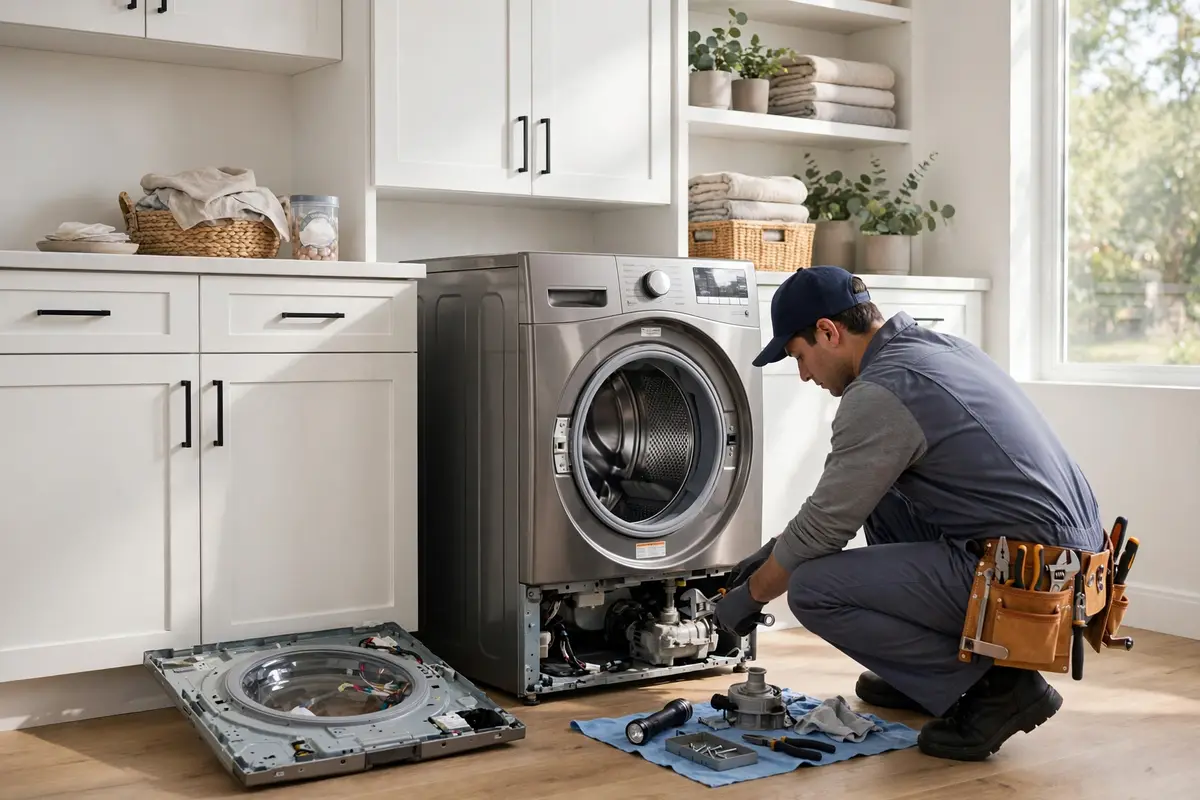
A washing machine that will not drain announces itself rudely: you open the door or lift the lid expecting a finished load and find your clothes swimming in cloudy water instead. On a front-loader the door stays locked, trapping the load hostage. On a top-loader the machine may refuse to spin, because a washer that cannot empty will not risk spinning a tub full of water. The instinct to keep restarting the cycle rarely helps — a drain failure is almost always physical, not a glitch — but the cause list is reassuringly short. In our experience running washer repair in Gastonia, the great majority of no-drain calls come down to something blocking the water’s path or a pump that has stopped moving it. Here is how to handle the standing water first, then work the causes in order.
Standing-Water First Aid: Do These Things First
- Stop the cycle and unplug the machine. Press cancel or pause, then pull the plug. Do not keep selecting drain-and-spin hoping it clears; a straining pump motor overheats, and a $0 clog can become a $200 pump.
- Protect the floor. Lay towels around the base, especially in front. Laundry rooms in many Gastonia homes sit over finished space, and even a few gallons spread further than you expect.
- Bail before you open anything (top-loaders). Scoop water out with a cup into a bucket until the level is manageable. On a front-loader, skip ahead to the filter step and work slowly — the water is behind that filter.
- Use the emergency drain hose if you have one. Most front-loaders hide a small drain tube next to the pump filter behind the lower front panel. Pull it out over a shallow pan, uncap it, and let the tub empty at a pace you control. Refill the pan as needed; a full tub can hold several gallons.
- Then open the pump filter over a shallow tray, slowly, a quarter-turn at a time (details in the causes below). Have the bucket ready for whatever escapes the filter housing along with the water.
- Do not force a locked front-load door. The lock releases when the water level drops. Forcing it breaks the latch and floods the floor in the same motion.
Once the water is out and the clothes are in a laundry basket (they will be heavy and dripping — carry them to a sink or tub), you can troubleshoot calmly instead of against a rising puddle.
What the Symptoms Are Telling You
Three observations narrow the field fast. Do you hear the drain pump? A healthy pump hums for 30 to 90 seconds at the drain stage. A pump that hums but moves no water points to a blockage at the filter, in the hose, or at the pump’s impeller. A pump that growls, clicks, or rattles suggests something hard — a coin, a screw, an underwire — is in the impeller or the pump itself is failing. Total silence at the drain stage, with the machine otherwise alive, suggests the pump is getting no power: a lid-switch, door-lock, wiring, or control issue. Where does the cycle stop? A machine that washes and rinses but balks at the final drain behaves differently from one that never drains at all. And is there an error code? Many models spell it out — F21 on Whirlpool, OE on LG, E24 on Bosch all mean drain trouble. Our washing machine error codes guide translates the common ones brand by brand; write the code down before you unplug, because some machines clear it.
The Main Causes of a Washer That Won’t Drain
1. Clogged pump filter or coin trap
This is cause number one, and it is not close. Every front-loader (and many newer top-loaders) routes drain water through a filter or coin trap designed to catch what leaves your pockets: coins, hairpins, buttons, screws, bra underwires, and the slow accretion of lint and hair. When the trap fills, flow slows, then stops. The filter lives behind a small panel at the bottom front of the machine. Unscrewing it after a no-drain episode is genuinely satisfying detective work — we have pulled out everything from a full set of guitar picks to a toddler’s sock, which, for the record, is also where missing socks actually go: past the tub seal and into the pump. Clean the filter under a tap, check the housing behind it for strays with a flashlight, and reinstall it snugly; a cross-threaded filter leaks.
2. Kinked, clogged, or badly installed drain hose
The drain hose is the other half of the water’s path. Hoses kink when the washer gets pushed back against the wall, clog internally with lint and detergent sludge over the years, and cause trouble when installed wrong: pushed too far down the standpipe (which can siphon water back), or sealed airtight into the standpipe instead of loosely fitted with an air gap. A hose can also simply be positioned too low, below the level the pump can lift against. Straightening a kink and reseating the hose in the standpipe — with the end secured but not sealed — are homeowner-level fixes. A hose clogged solid or cracked with age is a cheap part and a quick replacement, though getting to the machine-end connection sometimes means pulling the washer out, so mind the water supply lines when you move it.
3. Failed drain pump
When the path is clear and the water still will not move, suspect the pump itself. Drain pumps fail two ways: electrically, when the motor windings burn out (often after weeks of straining against a partial clog — which is why ignoring slow draining is expensive), and mechanically, when the impeller cracks, strips off its shaft, or jams on debris that made it past the filter. A pump that hums but whose impeller spins freely by hand with no resistance has usually stripped. A pump that is silent and tests open on a multimeter is electrically dead. Pump replacement is the most common true repair on this list — a mid-cost job on most brands, typically finished in one visit, and the part is a standard truck item for our technicians.
4. Faulty lid switch or door lock
Washers are programmed to protect you from yourself: a top-loader will not drain or spin if it believes the lid is open, and a front-loader will not start a drain-and-spin sequence with an unverified door lock. A lid switch cracked by years of lid slamming, or a front-load door lock with a burnt wax motor or broken latch, makes the control believe the machine is unsecured — so the cycle stalls, often right at the drain or spin stage, sometimes with a lock error code. This cause is sneaky because the pump is perfectly fine; it is simply never told to run. Testing a switch or lock assembly takes a meter and the wiring diagram, and replacements must match the model exactly, so this one usually graduates to a professional repair — but it is a satisfying one, because the fix is quick and the washer is otherwise healthy.
5. Control board or wiring problems
Least common, most misdiagnosed. If the pump tests good, the filter and hose are clear, and the lock is verified, the remaining suspects are the control board’s pump circuit and the wiring harness between board and pump — including the occasional wire chafed through by years of vibration. Board-level drain failures tend to follow electrical storms and power surges, which Gaston County summers supply generously. No technician should quote you a control board without first proving the pump is good and power is absent at the pump connector during the drain stage; that two-minute test separates a board problem from everything cheaper on this list.
| Cause | What you can check | Professional fix | Typical cost |
|---|---|---|---|
| Clogged pump filter / coin trap | Open the lower front panel; drain slowly into a tray; clean the filter | Deep clean trap and pump housing; test drain | $0 DIY · $79–$120 |
| Drain hose kink or clog | Check for kinks behind the machine; reseat hose in standpipe | Replace hose; correct standpipe installation | $110–$180 |
| Failed drain pump | Listen at drain stage: humming, rattling, or silent? | Replace drain pump and clear the full drain path | $170–$320 |
| Lid switch / door lock fault | Note lock or lid error codes; check the latch is not visibly broken | Replace switch or lock assembly | $130–$260 |
| Control board / wiring | Recall recent power surges; check for codes in our error-code guide | Prove power loss, then repair wiring or replace board | $220–$380 |
| Blocked standpipe / house drain | Watch whether water backs up at the standpipe while draining | Clear standpipe obstruction; advise on drain line | $90–$160 |
Washer repairs in Gastonia typically run $110–$380 overall. The flat $79 diagnostic is waived when you approve the repair, and quotes are given in writing before work starts.
What You Can Safely Check Yourself
With the water bailed out using the first-aid steps, a homeowner can legitimately cover the top two causes — the ones behind most no-drain calls — with no tools beyond a flashlight, a shallow tray, and a screwdriver for the access panel:
- Clean the pump filter exactly as described above. Take a photo of whatever you find in it; it tells the story of the failure.
- Straighten and inspect the drain hose. Follow it from the machine to the standpipe. No sharp kinks, no crushing, end inserted a few inches into the standpipe and secured with a zip tie or hook — not taped airtight.
- Check the standpipe. Pour a gallon of water down it from a bucket. If it takes water slowly or backs up, the restriction is in your house drain, not the washer.
- Run a short drain-and-spin test with the tub empty after your checks. Success should be obvious within two minutes: strong flow sound, tub empty, spin starting normally.
- Note any error code and cross-check it in our washing machine error codes guide before booking, so you can tell the dispatcher exactly what the machine is reporting.
When to Call a Professional
Call when the filter and hose are clear and the washer still will not drain (that is pump, lock, or control territory, all of which need testing rather than guessing); when the pump rattles or growls with something hard inside it; when you smell burnt electrical odor at the drain stage; or when water is leaking from under the machine in addition to not draining — a cracked pump housing or loose internal hose can do both, and running the machine risks real floor damage. Also call if the machine is a stacked or built-in unit you cannot safely pull out; access is half the job on those, and it is genuinely a two-person task. When you call, the brand, model number, error code, and whether the pump made noise are the four facts that get your repair scheduled and stocked correctly.
What the Repair Involves and What It Costs in Gastonia
On a service visit, the technician confirms the drain path end to end — filter, hoses, pump operation, then electrical supply to the pump — replaces the failed component, and runs a fill-wash-drain-spin test cycle before leaving, because a drain repair that is not tested under a full tub is a guess. The $79 diagnostic is waived with an approved repair, pricing is written and upfront, and the work carries a written 90-day minimum warranty. Most no-drain repairs land between $110 and $380, with pump replacement the most common invoice. If your washer is older and the quote surprises you, our repair or replace decision guide will help you sanity-check it against the machine’s age and replacement cost.
Prevention: Keeping the Drain Path Clear
- Clean the pump filter monthly — every two weeks in homes with pets or anyone working construction or landscaping around Gastonia, where grit and hair load filters fast.
- Empty every pocket, every time. Coins, screws, and hair ties are the top three pump killers we extract. A mesh laundry bag for small items pays for itself.
- Use the right amount of HE detergent — usually far less than the cap suggests. Excess suds slow draining, coat the hose interior, and mimic a blockage.
- Shake out work clothes and pet bedding outside before washing, so the grit and hair never reach the filter.
- Act on slow draining immediately. A washer that takes noticeably longer to empty is warning you while the fix is still a cleaning, not a pump.
Water still standing after the filter and hose checks? Book a visit online or call (704) 270-4863 — same-day washer repair is available across Gastonia, Belmont, Stanley, and the rest of Gaston County.