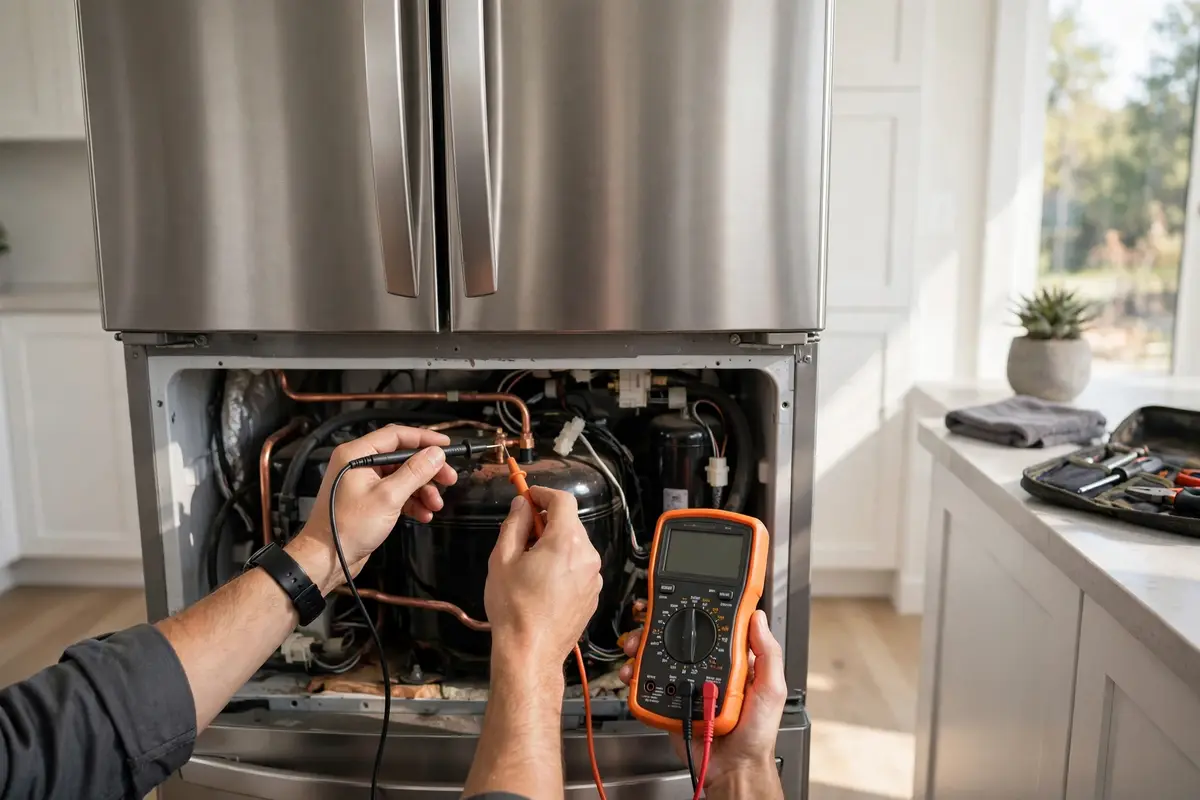
A refrigerator that stops cooling rarely fails all at once. Most of the time it drifts: the milk is not quite as cold on Monday, the ice cream is soft by Wednesday, and by the weekend the fresh-food section feels closer to room temperature than to a fridge. Catching it at the “not quite cold” stage matters, because the same fault that makes a fridge run warm also makes the compressor run longer — and a compressor that runs nonstop for days is a compressor that wears out years early. This guide walks through exactly how we diagnose a warm refrigerator in Gastonia homes, in the order we check things, so you can fix the simple causes yourself and recognize the ones that need a technician.
First, Protect Your Food: The Temperatures That Matter
Before troubleshooting, protect what is inside the box. A refrigerator should hold at or below 40°F in the fresh-food section — most technicians set them between 36°F and 38°F — and a freezer should hold 0°F. Those are not preferences; above 40°F, bacteria multiply fast enough that perishable food becomes a gamble. If you do not own an appliance thermometer, buy one for a few dollars at any Gastonia hardware store and leave it on the middle shelf. The number on the control dial or display is what the fridge wants to be, not proof of what it actually is.
Use the two-hour rule while you troubleshoot: perishable food — raw meat, poultry, seafood, milk, eggs, soft cheese, and leftovers — that has sat above 40°F for more than two hours should be thrown out, and if the interior climbed above 50°F for several hours, be aggressive about discarding. When in doubt, throw it out; a service call is cheaper than a night of food poisoning. Food that is still at 40°F or below can ride out a repair in a cooler packed with ice, and a full freezer that stays closed will hold safe temperatures for roughly 24 to 48 hours depending on how full it is. Keep the doors shut as much as possible while you work through the checks below — every door opening dumps the cold air you are trying to measure.
Read the Symptoms Before You Read the Causes
The pattern of warmth tells an experienced technician a lot before a single panel comes off. A fridge where the freezer is cold but the fresh-food section is warm almost always has an airflow problem — a failed evaporator fan, ice choking the evaporator, or a blocked vent — because nearly every modern refrigerator cools the fresh-food section with air borrowed from the freezer. A fridge where both sections are warm but the compressor is running points at dirty condenser coils, a condenser fan problem, or a sealed-system issue. Both sections warm and nothing is running — no hum, no fan, no click — suggests a control, thermostat, or start-component failure. Heavy frost on the freezer back wall is the signature of a defrost failure. And a fridge that cycles on and off every few minutes with a click is often a weak start relay or an overheating compressor. Note your pattern before you start; it decides which of the eight causes below deserve your attention first.
The 8 Most Common Causes of a Refrigerator Not Cooling
1. Dirty condenser coils
This is the single most common cause we find in Gaston County, and the most neglected. The condenser coils — under the fridge or behind a rear panel, depending on the model — are where the refrigerant sheds the heat it collected inside the box. When those coils are matted with dust, pet hair, and kitchen grease, the heat has nowhere to go. The fridge still runs, but it runs hot, long, and inefficiently, and the interior temperature creeps up a degree at a time. Homes with dogs or cats, and fridges pushed tight against a wall with no rear clearance, are the worst cases. The fix is mechanical, not electronic: unplug the unit, remove the kick plate or rear cover, and vacuum and brush the coils clean. On a badly neglected fridge this one cleaning can drop the interior temperature back into range within a few hours.
2. Evaporator fan motor failure
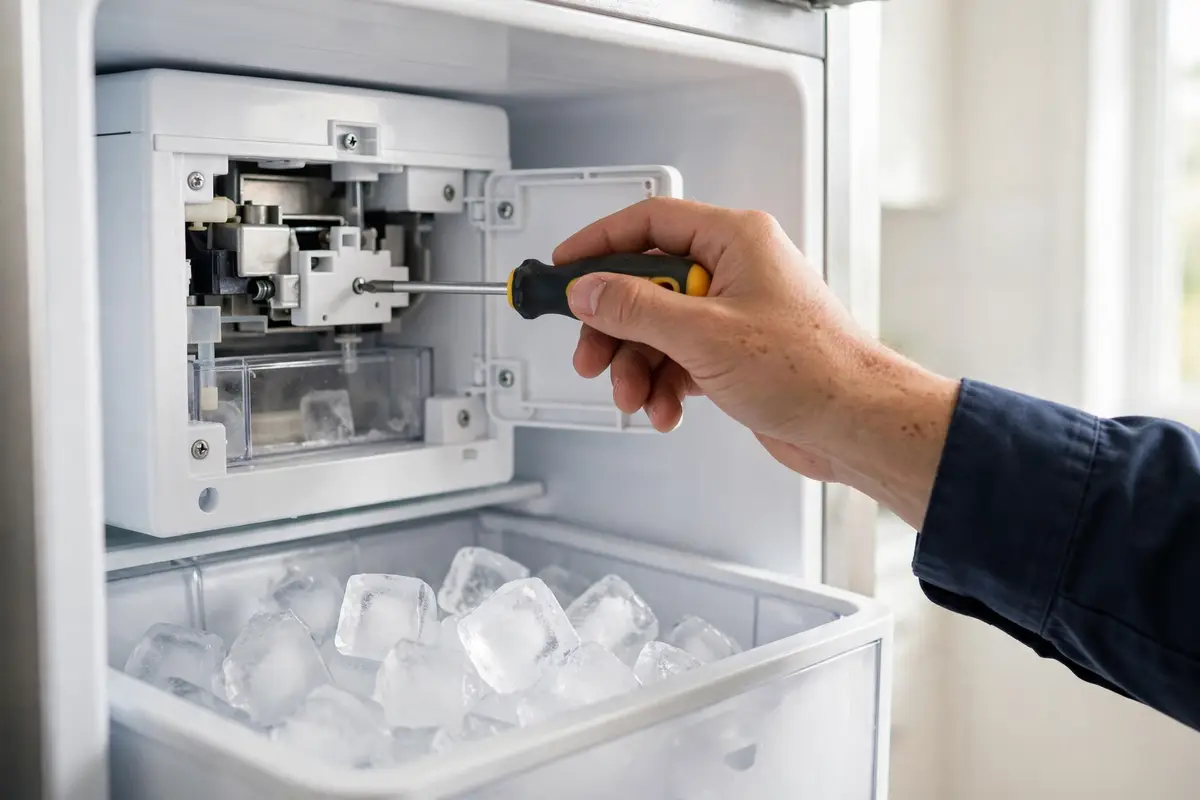
The evaporator fan sits in the freezer, behind the back panel, and its job is to blow air across the cold evaporator coils and circulate that air into both compartments. When the motor burns out, a blade breaks, or ice builds up until the blade cannot turn, the freezer coils get plenty cold — but the cold never moves. The classic symptom is a freezer that feels fine and a fresh-food section ten to fifteen degrees too warm, sometimes with frost creeping across the freezer back wall because the air is stagnant. Open the freezer and listen: with the compressor running, you should hear the fan. Pressing the door switch should start it if it was interrupted by the open door. Silence, a grinding buzz, or a fan that wobbles and stops all point the same direction.
3. Condenser fan failure
Down by the compressor sits a second, smaller fan that pulls air across the condenser coils and over the compressor itself. When it fails, the compressor overheats and eventually trips off on its thermal overload, then cools, restarts, overheats again — which is why this fault often presents as a fridge that cools decently in the morning and is warm by evening. Debris is the usual killer: a stray plastic bag, a twist tie, or a decade of dust can stall the blade. A dead motor or a blade spinning loosely on its shaft needs replacement. Because this fan also protects the compressor, a fridge with a dead condenser fan should not be left running for days while you “see how it goes.”
4. Defrost system failure
Frost-free refrigerators melt the ice off their evaporator coils automatically, usually once or twice a day, using a heater, a defrost thermostat or sensor, and a timer or control board. When any leg of that system fails — the heater burns open, the thermostat stops closing, or the board never starts a defrost cycle — ice accumulates on the evaporator day after day. The ice blanket insulates the coils and strangles airflow, and the fridge warms up gradually over one to two weeks. The giveaway is thick, white frost across the entire freezer back panel, sometimes pushing out around the panel edges. Manually defrosting the fridge (unplug it, doors open, 12 to 24 hours) will restore cooling temporarily, which actually confirms the diagnosis — but the frost will be back within a week or two unless the failed defrost component is replaced.
5. Faulty thermostat or electronic control
The temperature control — a mechanical thermostat on older models, a sensor-and-board combination on newer ones — is what tells the compressor when to run and when to rest. A thermostat that fails in the “satisfied” position makes the fridge believe it is cold when it is not, so the compressor simply never gets the call to run. Symptoms include a fridge that is warm but eerily quiet, settings that seem to change nothing no matter where you set them, or wild temperature swings — frozen lettuce one day, warm milk the next. Sensors drift out of calibration too, reading several degrees colder than reality. Testing a thermostat or sensor properly takes a multimeter and the model’s resistance chart, which is why this one usually moves from the DIY column to the pro column fairly quickly.
6. Compressor trouble or a failed start relay
The compressor is the heart of the sealed system, and the start relay is the small component that gives it the electrical push to start. Relays fail far more often than compressors do, and they fail cheaply: a fridge that clicks every couple of minutes, hums briefly, and then clicks off again is very often a $20 relay rather than a dead compressor. A relay that rattles when shaken or smells burnt is done. A true compressor failure — locked rotor, burnt windings, or a compressor that runs but no longer pumps effectively — is the most serious diagnosis on this list, and it is the one case where we sit down with the homeowner and run the repair-versus-replace numbers honestly, because sealed-system work is the most expensive repair a fridge can need. Never let anyone condemn a compressor without testing the relay and capacitor first.
7. Worn or torn door gaskets
A door gasket’s job is unglamorous and essential: seal the cold in and the warm, humid Gastonia summer air out. Gaskets harden, crack, tear at the corners, and pull away from the door over the years, and every gap is a continuous leak the compressor has to fight around the clock. The signs are condensation or “sweating” around the door frame, frost building near one corner of the freezer, a fridge that runs almost constantly, and doors that no longer feel like they pull themselves the last inch closed. The dollar-bill test is definitive: close the door on a bill at several points around the frame. If the bill slides out with no resistance, that section of gasket is not sealing. Minor gaps sometimes respond to cleaning and gentle heat reshaping; torn or hardened gaskets need replacement.
8. Blocked vents and an overpacked fridge
The cheapest cause on the list. Cold air enters the fresh-food section through vents, usually on the back wall or upper side, and it has to circulate to work. A fridge packed wall-to-wall — with a grocery bag or a large container parked directly against the vent — starves the rest of the compartment of airflow. Some spots get too warm while food right against the vent freezes. The same goes for the freezer: a vent buried behind stacked frozen boxes will warm the fresh-food section downstream. Rearrange so there is a clear path in front of every vent, leave roughly an inch of space between items and the walls, and keep the fridge about two-thirds to three-quarters full — enough mass to hold temperature, enough space for air to move.
| Cause | What you can check | Professional fix | Typical cost |
|---|---|---|---|
| Dirty condenser coils | Unplug, pull the kick plate, look for dust and pet-hair matting on the coils | Deep coil cleaning and airflow check | $79–$130 |
| Evaporator fan failure | Listen at the freezer for fan noise; press the door switch to trigger it | Replace evaporator fan motor | $185–$315 |
| Condenser fan failure | Check for debris blocking the blade near the compressor | Replace condenser fan motor | $165–$285 |
| Defrost system failure | Look for thick frost covering the freezer back panel | Replace heater, defrost thermostat, or control | $195–$355 |
| Thermostat / control fault | Confirm settings; note wild swings or a fridge that never runs | Test and replace thermostat, sensor, or board | $155–$295 |
| Start relay failure | Listen for click–hum–click cycling every few minutes | Replace start relay and test compressor | $120–$210 |
| Compressor failure | No safe DIY test — note sounds and call with the model number | Sealed-system compressor replacement | $390–$480 |
| Worn door gaskets | Dollar-bill test at several points around both doors | Replace door gasket and align door | $150–$260 |
| Blocked vents | Find the vents and clear food away from them; recheck in 4 hours | Airflow correction during diagnostic visit | $0–$79 |
Costs are typical parts-and-labor ranges for Gastonia. Our diagnostic is a flat $79, waived when you approve the repair, and every repair is quoted in writing before work begins. See the full breakdown on our refrigerator repair cost guide.
What You Can Safely Check Yourself
None of the following requires opening a sealed panel or touching wiring, and together they rule out the majority of service calls we run:
- Verify the settings. Fresh food at 37–38°F, freezer at 0°F. Controls get bumped by milk jugs more often than anyone admits, and a fridge set to its warmest setting will feel broken in a hot kitchen.
- Measure the real temperature. Put an appliance thermometer on the middle shelf, wait at least four hours with the door closed, and write the number down. Feelings are unreliable; a number tells you whether you have a crisis or a nuisance.
- Clean the condenser coils. Unplug the fridge first. Remove the front kick plate or rear lower cover, then use a coil brush and vacuum to clear the coils completely. This is the highest-value ten minutes in refrigerator ownership.
- Run the dollar-bill gasket test around both doors, and wash the gaskets with warm soapy water while you are there — sticky residue alone can break a seal.
- Clear the vents inside both compartments and re-space anything packed tight against the back wall.
- Listen carefully. With the fridge running: fan in the freezer? Fan and compressor hum below? Clicking cycles? What you hear is genuinely useful diagnostic information — jot it down for the technician.
- Check the obvious electricals. Confirm the plug is fully seated and the breaker has not tripped, especially after a thunderstorm or a Duke Energy flicker, which are not rare in Gaston County summers.
Give the fridge four to six hours after any fix before judging the result. A full refrigerator changes temperature slowly, and opening the door every twenty minutes to check resets the clock each time.
When to Call a Professional
Call rather than keep digging when any of the following is true. The fridge is warm in both sections and the compressor is silent or only clicks. You see heavy frost on the freezer back wall that returns within days of a manual defrost. The compressor runs constantly but temperatures keep climbing — that pattern can be a sealed-system problem, and sealed refrigerant work is legally and practically technician-only territory. There is any sign of electrical damage: a burnt smell, a scorched outlet, or a breaker that trips again after resetting. Or the food-safety clock has simply run out — if perishables have been above 40°F for hours and the fridge is not responding to the basic checks, the fastest path to saving the next grocery load is a same-day visit, not another evening of experimenting.
When you call, have the brand and model number ready (it is on a sticker inside the fresh-food section), the thermometer reading if you took one, and your symptom pattern — freezer cold and fridge warm, everything warm, frost or no frost. That thirty-second report genuinely shortens the diagnostic, which is how our refrigerator repair service in Gastonia finishes most of these repairs in a single visit.
What the Repair Involves and What It Costs in Gastonia
A professional visit starts with measurement, not parts-swapping: actual compartment temperatures, fan and compressor operation, coil condition, defrost-system tests, and gasket inspection, in roughly that order because the cheap causes are also the common ones. The diagnostic is a flat $79, and it is waived when you approve the repair. You get a written quote before any part is ordered, and most fan, relay, thermostat, and defrost repairs are finished the same visit from parts on the truck. Compressor and control-board work occasionally needs an ordered part, in which case we will tell you exactly how long the fridge can limp along safely and how to protect your food in the meantime. Every repair carries a written warranty of 90 days minimum on parts and labor, so if the same fault comes back, so do we — at no charge.
Across the full range of warm-fridge faults, most Gastonia homeowners land between $120 and $480 total, with the fan, relay, and gasket repairs that dominate our schedule sitting in the lower half of that range. If your fridge is older and the quote lands in the upper half, read our guide on repair or replace: how to decide before you approve anything — the 50% rule math takes two minutes and we would rather you run it than wonder about it later.
Prevention: Keeping the Next Warm-Fridge Call From Happening
- Clean the coils every 6 to 12 months — every 6 if you have pets. Put it on the same schedule as your HVAC filter changes so it actually happens.
- Hold the settings at 37–38°F and 0°F. Colder settings do not preserve food better; they just run the compressor harder and can freeze the fresh-food vents shut.
- Wash gaskets twice a year and inspect for tears at the corners, where they always fail first.
- Leave breathing room. An inch behind and beside the fridge for heat to escape, and clear space in front of the interior vents.
- Cool food before it goes in. A stockpot of hot soup raises the whole compartment’s temperature for hours.
- Keep a thermometer in the fridge permanently. A drift from 37°F to 43°F over a month is your early warning — caught then, it is usually a cleaning or a fan, not a compressor.
Still warm after the checks above? Our team covers Gastonia, Belmont, Dallas, Mount Holly, and all of Gaston County with same-day appointments. You can request service online or call (704) 270-4863 — and if your dryer is also acting up, our companion guide on a dryer not heating walks through that diagnosis the same way.