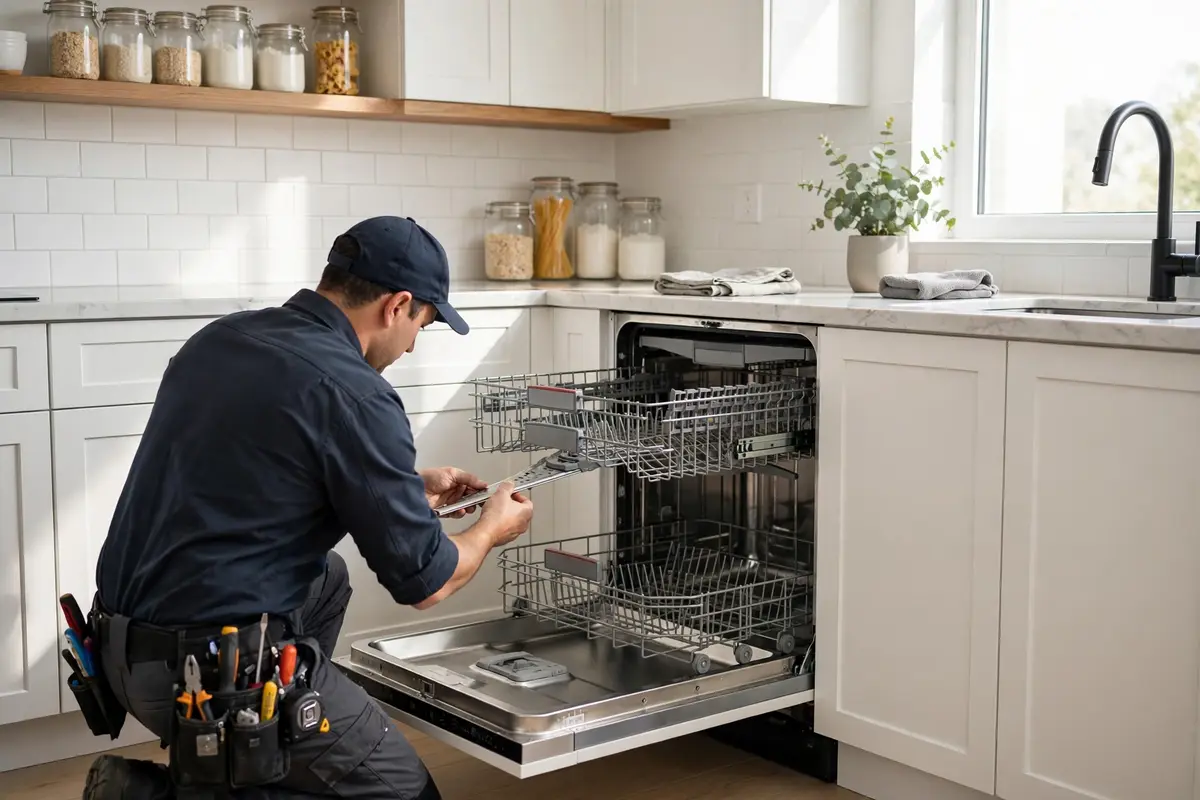
A dishwasher that does not clean is more annoying than one that does not run at all, because it wastes a full cycle’s worth of water, power, and hope before disappointing you. The dishes emerge with grit in the glasses, a chalky film on everything, or — worst of all — food still attached, and you end up washing by hand anyway. The failure is confusing because the machine sounds fine: it fills, it hums, it drains. But cleaning is a system with four ingredients — water coverage, water temperature, detergent action, and drainage — and a weakness in any one of them produces dirty dishes while everything else appears normal. On dishwasher repair calls in Gastonia, we work through the causes below in order, from the ten-minute fixes at the top to the pump at the bottom. Most households find their answer in the first three.
Start by Reading the Evidence on the Dishes
The pattern of what is left behind is diagnostic gold, so look before you unload everything into the sink. Grit and sand-like particles on upper-rack items usually mean redeposited debris — a clogged filter or spray system is washing food off the plates and then spraying it back. A white or cloudy film on glassware points at hard-water mineral deposits or detergent trouble. Food still stuck to lower-rack plates but clean glasses above suggests the lower spray arm is not turning or its jets are blocked. Everything uniformly mediocre — nothing filthy, nothing truly clean — suggests weak water pressure from the wash pump or water that never gets hot enough. And dirty water pooled in the bottom after the cycle means a drainage problem is undoing the wash. Note which pattern you have; it decides where to start below.
The Causes, From Most to Least Common
1. Clogged spray arms
Spray arms clean by force: water jets out of small holes, and the reaction spins the arm while the streams scour the dishes. Those holes are exactly the size to trap seeds, bone fragments, glass chips, and — in Gaston County — flakes of mineral scale. A spray arm with half its jets blocked does not just spray less; it often stops rotating entirely, so whole zones of the tub get rinsed with yesterday’s drips instead of pressurized water. Most spray arms lift, unscrew, or unclip by hand with no tools. Hold the arm up to the light, and clear each jet with a toothpick or a straightened paper clip, then rinse the arm out backwards under the tap. Spin each arm by hand before closing the door — it should turn freely with no wobble or grinding.
2. A dirty or damaged filter system
Nearly every modern dishwasher has a removable filter in the tub floor, and it is the most neglected maintenance item in the kitchen. Its job is to trap food debris so the pump does not recirculate it. A filter matted with grease and food pulp forces the wash water through a steadily dirtier screen with every cycle — the dishwasher is quite literally washing your dishes in filtered food soup, which explains the grit problem in the symptom list perfectly. Twist the cylindrical filter out (it usually turns a quarter-turn counterclockwise), wash it in hot soapy water with a soft brush, and check it against the light: a filter whose fine mesh is torn, warped, or permanently glazed with grease needs replacing, which is an inexpensive part. While it is out, reach into the sump (carefully — broken glass collects there) and remove any debris you find.
3. Water that never gets hot enough
Dishwasher detergent is engineered to activate fully in water around 120°F. Below that, enzymes stall, grease does not emulsify, and dishes come out greasy and filmed no matter how good everything else is. Two things cause low wash temperature in Gastonia homes. The first is simple plumbing physics: if your water heater is set low, or the dishwasher sits at the end of a long pipe run, the first gallons arriving are the cooled water that sat in the line. The free fix is to run the kitchen tap until the water runs hot before starting the dishwasher — it takes thirty seconds and transforms results in homes with long runs. The second cause is a failed heating element or thermostat in the dishwasher itself, which also shows up as dishes that are still wet at the end of a heated-dry cycle. That one is a technician repair, but the tap trick tells you which problem you have: if running the tap first fixes the cleaning, your dishwasher’s heater is fine and your pipes were the issue.
4. A weak or failing water inlet valve
The inlet valve meters the water entering the tub. When its screen clogs with sediment — common on Gaston County’s municipal water after main breaks or hydrant flushing stir up the lines — or when the valve’s solenoid weakens, the dishwasher underfills. A dishwasher washing with two gallons instead of four produces weak spray, poor coverage, and gritty residue, and it often sounds different: a harsher, hollower spray noise, because the pump is starving. One field check: open the door mid-fill and look at the water level once filling stops. On most models it should reach near or just below the heating element. A clearly low level points to the valve or its screen. Valve replacement is a moderate repair that involves the water supply shutoff, so it is normally a pro job — but it is a satisfying one, because the improvement is night-and-day.
5. Detergent problems: old, wrong, or drowned
Detergent causes more phantom “broken dishwasher” calls than any part failure. Powder and pods stored under a humid sink absorb moisture and lose potency within months; pods tossed into the tub floor instead of the dispenser dissolve during the pre-rinse and are gone before the main wash begins; and a dispenser door that fails to open — usually because a tall pan or cutting board blocked it — means the load washed with plain water. Gel detergent underperforms in hard water compared with powder or quality pods. Test this cause before suspecting hardware: buy a small fresh box of a good detergent, put a pod in the dispenser (not the tub), confirm nothing tall blocks the dispenser door, and run a hot cycle. A stubborn share of cleaning complaints ends right there, at a cost of about six dollars.
6. Hard water in Gaston County
Gastonia’s water is moderately hard, and in some neighborhoods and well-water homes around Gaston County it runs harder. Dissolved calcium and magnesium precipitate onto hot surfaces and glassware as the white, chalky film that will not wipe off — and once etched, glass stays cloudy permanently. Mineral scale also narrows spray-arm jets and coats the filter and heating element, quietly degrading cleaning for months before anyone connects the dots. The countermeasures are unglamorous and effective: use rinse aid (it is functional, not cosmetic — it makes water sheet off instead of beading and depositing minerals), choose a detergent with water-softening agents, and run an empty hot cycle with a dishwasher cleaner or a cup of white vinegar on the top rack monthly to dissolve scale before it compounds. Homes on well water with persistent filming should consider whether a softener makes sense; that is a plumbing conversation, but we will happily tell you what we see in your machine’s sump.
7. Loading mistakes that defeat the machine
Some cleaning failures are geometry, not mechanics. Bowls nested together, a large sheet pan parked against the left wall blocking the upper spray arm’s rotation, cups placed so they shield the items below them, spoons nested into a solid stack the water cannot penetrate — the dishwasher cannot clean what the water cannot reach. The rules that fix most loads: face dirty surfaces down and toward the center; never let any item block a spray arm’s rotation (spin both arms by hand after loading to prove it); separate nested cutlery or alternate spoons up and down; keep tall items out of the dispenser’s swing path; and do not pre-rinse plates to a shine — modern detergents and soil sensors actually need some food soil to work against, and a nearly clean load can trigger a shorter, weaker sensor cycle. Scrape, do not rinse.
8. A failing wash (circulation) pump
At the bottom of the list sits the pump that pressurizes the whole wash system. As a circulation pump’s motor weakens or its impeller wears, spray pressure falls off across every jet at once. The signature is the uniform mediocrity described earlier: the machine fills, heats, and drains correctly, the arms are clean, and yet nothing comes out properly clean — because the water is arriving as a drizzle instead of a scouring jet. A failing pump may also sound labored, or whine at a pitch it did not used to make. Pump replacement is the most involved dishwasher repair on this list and the one where age matters most to the decision; on a nine- or ten-year-old dishwasher, run the numbers in our repair or replace guide first. On a younger machine it is a sound repair, well inside the normal $110–$350 dishwasher range.
| Cause | What you can check | Professional fix | Typical cost |
|---|---|---|---|
| Clogged spray arms | Remove arms; hold jets to the light; clear with a toothpick | Descale or replace spray arms | $0 DIY · $110–$170 |
| Dirty / damaged filter | Twist out the tub filter; wash in hot soapy water | Replace filter; deep-clean sump and pump intake | $0 DIY · $110–$190 |
| Low water temperature | Run the kitchen tap hot before starting; check heater setting (120°F) | Replace heating element or thermostat | $150–$290 |
| Weak inlet valve | Check mid-fill water level reaches near the element | Replace inlet valve; flush supply screen | $140–$260 |
| Detergent issues | Fresh detergent, pod in the dispenser, door path clear | Replace dispenser assembly if the door fails | $0–$6 DIY · $130–$240 |
| Hard-water scale | White film on glasses; vinegar test on one glass | Full descale service; element and jet cleaning | $110–$180 |
| Loading mistakes | Spin both spray arms by hand after loading; unblock dispenser | Not a repair — loading correction during visit | $0 |
| Failing wash pump | Uniform weak cleaning with clean arms and filter | Replace circulation pump / motor assembly | $240–$350 |
Dishwasher repairs in Gastonia typically run $110–$350 overall, with a flat $79 diagnostic that is waived when you approve the repair.

What You Can Safely Check Yourself, in Order
- Clean the filter — ten minutes, no tools, biggest single improvement for most households.
- Clear and spin the spray arms, and re-check their rotation after every loading change.
- Run the kitchen tap hot before starting the cycle, and confirm your water heater is set near 120°F.
- Fresh detergent, in the dispenser, with rinse aid in the rinse-aid reservoir. Give it two cycles to judge.
- Run an empty cleaning cycle with a dishwasher cleaner or vinegar to strip accumulated grease and scale from the whole system.
- Reload by the geometry rules for a week. If the pattern of dirt changes with loading, you have found your cause.
Work the list in order and change one thing at a time. Shotgunning every fix at once might clean the dishes, but you will never know which problem you had — and it may be back in a month.
When to Call a Professional
Call when the DIY sequence does not move the needle — that means the cause is mechanical or electrical: a wash pump losing pressure, an inlet valve underfilling, a heater that never heats, or a dispenser that will not open. Also call if you find pooled water under the machine, a burning smell during the cycle, or error codes pointing at fill, heat, or drain faults. When you book, tell us the pattern you observed — grit, film, lower-rack failure, or uniform weak cleaning — because it genuinely changes which parts go on the truck. Our contact page takes requests around the clock, and same-day appointments run across Gastonia, Cramerton, Belmont, and Lowell.
What the Repair Involves and What It Costs in Gastonia
A professional cleaning-performance visit tests the four ingredients in sequence: fill level and valve operation, wash-water temperature at the element, spray pressure and arm rotation, and drain performance — because a dishwasher that drains poorly re-deposits soil in the final rinse. You get a written quote after the $79 diagnostic (waived on repair), most parts are truck stock, and the finished repair runs a loaded test cycle before we leave, with a written 90-day minimum warranty behind it. Expect most outcomes to land in the $110–$350 range — and expect us to say so if the honest answer is that your machine only needed its filter cleaned.
Prevention: Keeping Dishes Coming Out Clean
- Wash the filter monthly. Put it on the first of the month with the HVAC filter and the fridge-coil schedule.
- Always run rinse aid in Gaston County water — it is the cheapest hard-water defense there is.
- Scrape, do not pre-rinse, and buy detergent in small quantities so it stays fresh and dry.
- Run the tap hot first in homes where the dishwasher sits far from the water heater.
- Monthly empty hot cycle with cleaner to keep scale and grease from compounding inside arms, sump, and element.
Still getting gritty glasses after the checklist? Call (704) 270-4863 and tell us the pattern — we will bring the right parts the first time. And if it is the fridge acting up instead, our guide to a refrigerator not cooling starts that diagnosis the same practical way.