10 Signs Your Water Heater Is Failing
By the Appliance Repair Gastonia NC team • October 2026 • Gastonia, NC
Water heaters rarely die without warning. They rust, rumble, leak, and run lukewarm first — often for months. Learn the ten warning signs, how urgent each one is, and when a repair still makes sense.
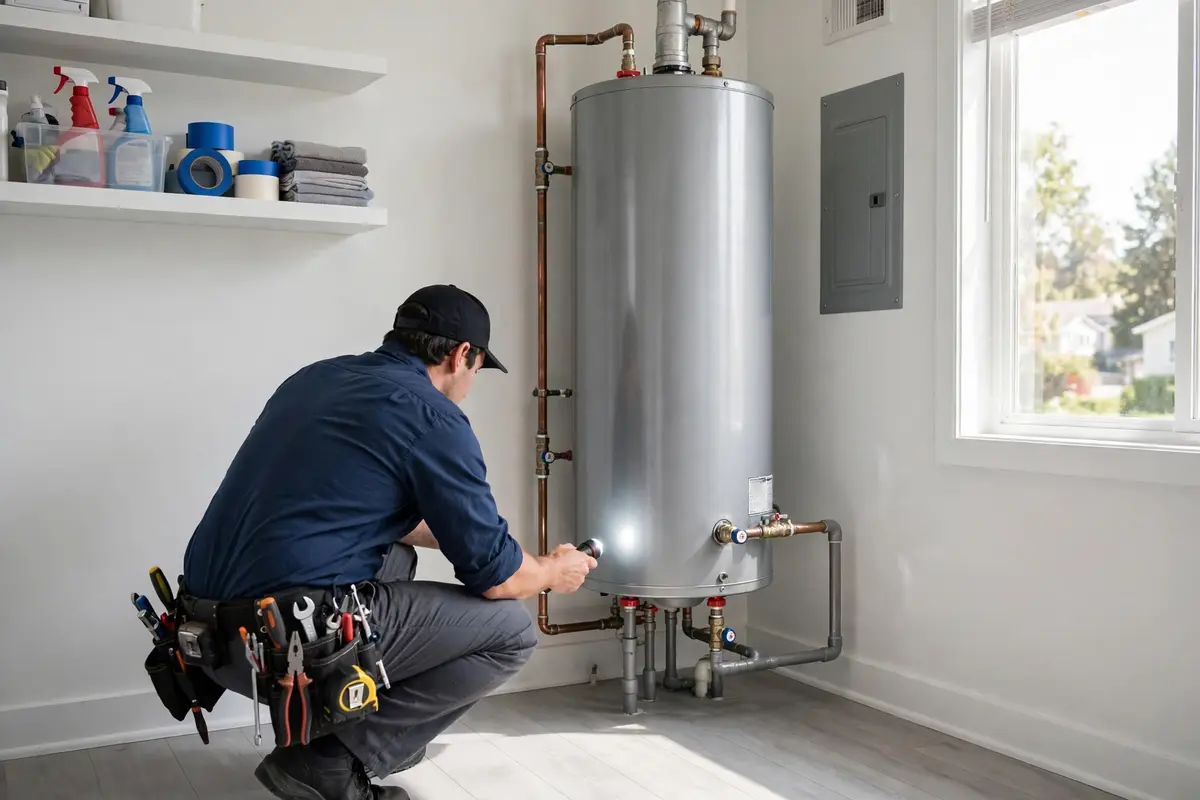
A water heater is the most ignored appliance in most Gastonia homes — until the morning it delivers a cold shower, a flooded garage, or both at once. The frustrating truth is that tank water heaters almost always announce their decline. They do it quietly, over months: a little rust in the water, a new rumble during heating, a drip that dries by noon. Homeowners who catch those signals early usually get a repair or a planned replacement on their own schedule. Homeowners who miss them get an emergency, and water heater emergencies are expensive in a way that has little to do with the heater itself — it is the flooring, drywall, and stored belongings that a failed tank soaks.
Below are the ten warning signs we take most seriously on service calls across Gaston County, what each one means mechanically, and how urgent it really is. If several of them sound familiar, our water heater repair in Gastonia NC page explains same-day service and pricing, and the appliance repair cost in Gastonia NC guide puts water heater work in context with the rest of your appliances.
The 10 Signs, Rated by Urgency
| Warning Sign | What It Usually Means | Urgency |
|---|---|---|
| 1. Age over 10–12 years | Tank and anode rod near end of design life | Monitor — plan ahead |
| 2. Rusty or discolored hot water | Anode rod spent; tank interior corroding | Schedule |
| 3. Rumbling, popping, banging | Sediment layer overheating at the tank bottom | Schedule |
| 4. Water leaking from the tank body | Tank corrosion has perforated the steel | Urgent |
| 5. Lukewarm water or short hot showers | Failed element, burner issue, or sediment insulation | Schedule |
| 6. Pilot light will not stay lit | Thermocouple, gas valve, or venting fault on gas models | Schedule |
| 7. T&P valve dripping | Excess pressure/temperature, or a failed relief valve | Urgent |
| 8. Cloudy water, rotten-egg smell | Sediment and bacterial growth in a neglected tank | Monitor — schedule a flush |
| 9. Repairs getting frequent | Multiple systems aging out together | Schedule — plan replacement |
| 10. Puddles around the base | Fitting leak, drain valve leak, or early tank failure | Schedule; urgent if growing |
Monitor means keep it on your list and mention it at your next service visit. Schedule means book within days, not months. Urgent means today: shut off the water supply to the heater and its power or gas, and call. The rest of this article explains each sign in the order homeowners usually notice them.
Sign 1: The Heater Is Simply Old
Conventional tank water heaters are built for roughly eight to twelve years of service. The manufacture date is encoded in the serial number on the rating plate — the first digits typically give the year and month or week. A heater in a Gastonia home installed in 2013 is living on borrowed time no matter how well it behaves, because the sacrificial anode rod that protects the tank from corrosion is long gone and the glass lining develops micro-cracks with every heating cycle. Age alone is not a reason to replace a working heater tomorrow, but it changes the math on every repair: putting a $300 part into a thirteen-year-old tank is a gamble, while the same part in a six-year-old tank is routine maintenance.
Sign 2: Rusty Hot Water
Run the hot tap into a white bucket or tub. If the hot water is tinted brown or rusty while the cold runs clear, the corrosion is inside your water heater. Early on, this can still be a save: if the tank itself has not perforated, replacing the spent anode rod and flushing the tank can restore clean water and add years of life. If rust appears alongside leaks or age past twelve years, the tank wall itself is rusting from the inside out, and no part replacement fixes tank steel. Rusty water at multiple fixtures, staining laundry, or a metallic taste all belong to this same sign — the heater is dissolving, slowly, into your plumbing.
Sign 3: Rumbling, Popping and Banging
Gaston County water carries minerals, and minerals settle. Year by year, sediment builds a crust on the tank floor. Water trapped beneath that crust flashes to steam as the burner or elements fire, producing the kettle-like rumbling and popping owners describe as the heater "making popcorn." The sound is more than annoying: the sediment insulates the tank bottom, forcing longer, hotter heating cycles that stress the steel and lining, waste energy, and cook electric elements. A professional flush can remove loose sediment from a mid-life tank and quiet it down. On an old tank that has never been flushed, we are honest — the drain valve may clog or the disturbance may expose a weak spot — which is why flushing belongs in a maintenance routine from early in the heater's life, not as a last resort at year eleven.
Sign 4: Leaks From the Tank Body
This is the one non-negotiable sign. Water seeping from the tank body itself — not from a pipe fitting, not from the drain valve, not from the relief valve discharge — means the steel vessel has corroded through. Tanks cannot be patched reliably. A body leak starts as a weep and ends as a rupture, and a forty- or fifty-gallon rupture in a garage, closet, or attic-adjacent space in Bessemer City or Cherryville can do thousands of dollars of water damage in an hour. If you see this sign: turn off the cold-water inlet to the heater, switch off its breaker or gas, attach a hose to drain it if you can do so safely, and call the same day. This is a replacement conversation, and the sooner it happens, the drier your house stays.
Sign 5: Lukewarm Water and Short Showers
When hot showers get shorter, the heater is losing capacity or output. On electric models, one of the two elements often fails, leaving the unit heating with half its power — the water gets warm, never properly hot, and runs out fast. On gas models, a weak burner, a failing gas control valve, or heavy sediment produces the same complaint. A broken dip tube creates a sneakier version: cold inlet water mixes at the top of the tank, so the first minutes are hot and then the temperature collapses. Most of these are genuine repairs — elements, thermostats, valves, and dip tubes are replaceable parts — which is why lukewarm water on a mid-life heater deserves a diagnostic before anyone talks you into a replacement.
Sign 6: Pilot and Ignition Trouble
A gas water heater whose pilot will not stay lit is usually reporting a thermocouple that no longer generates enough signal, a gas control valve problem, or a venting and combustion-air issue that keeps tripping safety limits. Modern electronic ignition models flash diagnostic codes on the control instead. Occasional pilot outages after a storm or a gas service interruption are unremarkable. A pilot that needs relighting every week is a heater asking for service — and repeated relighting attempts without a fix also mean repeated cold showers, which most Gastonia households tolerate for exactly one week before calling.
Sign 7: The T&P Valve Drips
The temperature-and-pressure relief valve is the heater's last safety device, designed to open before excess pressure can turn a tank dangerous. A valve that drips occasionally during heating cycles may be reporting genuinely high pressure — from a failed pressure-reducing valve on the house supply or a closed thermal-expansion system — or the valve itself may simply be worn. Either way, treat a dripping T&P as urgent until proven innocent, and never cap, plug, or ignore it. Replacing the valve is inexpensive; diagnosing why it opened protects everything downstream of it.
Signs 8, 9 and 10: Smell, Repair Frequency and Puddles
Cloudy water and a rotten-egg smell point to sediment and bacterial activity in a tank that runs too cool or sits underused — common in guest bathrooms and vacation stretches. A flush and a temperature check usually cure it. Repair frequency is the economic sign: a heater that needed a valve in spring, an element in summer, and now rumbles and rusts by fall is telling you its systems are failing together, and planned replacement beats the third emergency call. Puddles around the base require detective work, because the fix ranges from tightening a fitting or replacing a $30 drain valve to the urgent tank-body leak of Sign 4. Trace the water upward with a dry paper towel: fittings at the top, the relief valve discharge pipe, the drain valve, and only then the tank seams. Where the towel gets wet first is where your answer lives.
Repair or Replace? The Honest Math
Our general framework in the repair or replace guide applies cleanly here. Repair when the tank is sound, the heater is under ten years old, and the fault is a part — element, thermostat, valve, igniter, anode rod. Replace when the tank leaks, rust is advanced, the unit is past twelve years, or repair costs approach half the price of a new installed heater. Water heater work in Gastonia typically runs $130–$550 for repairs, and our water heater repair in Gastonia NC visits start with the $79 diagnostic, waived when you approve the repair, so you can make the call with real numbers instead of guesses.
The worst outcome is the unplanned one — the Saturday-night tank failure with water spreading across the garage floor in Dallas or Stanley. If your heater is showing two or more signs on this list, schedule the inspection while it is still your choice. Call (704) 270-4863, tell us the age and the symptoms, and we will tell you honestly whether we expect to repair it, maintain it, or help you plan its replacement before it plans the timing for you. Pair that visit with the seasonal habits in our appliance maintenance checklist — an annual flush and anode check are the two habits that move most water heaters from the ten-year column to the fifteen-year column.
Water Heater Showing Warning Signs?
Do not wait for the cold shower or the flooded garage. A Gastonia technician can inspect, flush, or repair your water heater — and tell you honestly if replacement is smarter. Call (704) 270-4863 — Mon–Sat 7am–8pm, Sun 9am–5pm.
📍 Serving Gastonia & Gaston County, NC
🕐 Mon–Sat 7:00 AM – 8:00 PM • Sun 9:00 AM – 5:00 PM
🌐 appliancerepairgastonianc.com